
Affordable Housing
Brownfield Redevelopment in Cleveland: The Slow Truth
By Derek Anders • September 11, 2025 • 8 min read
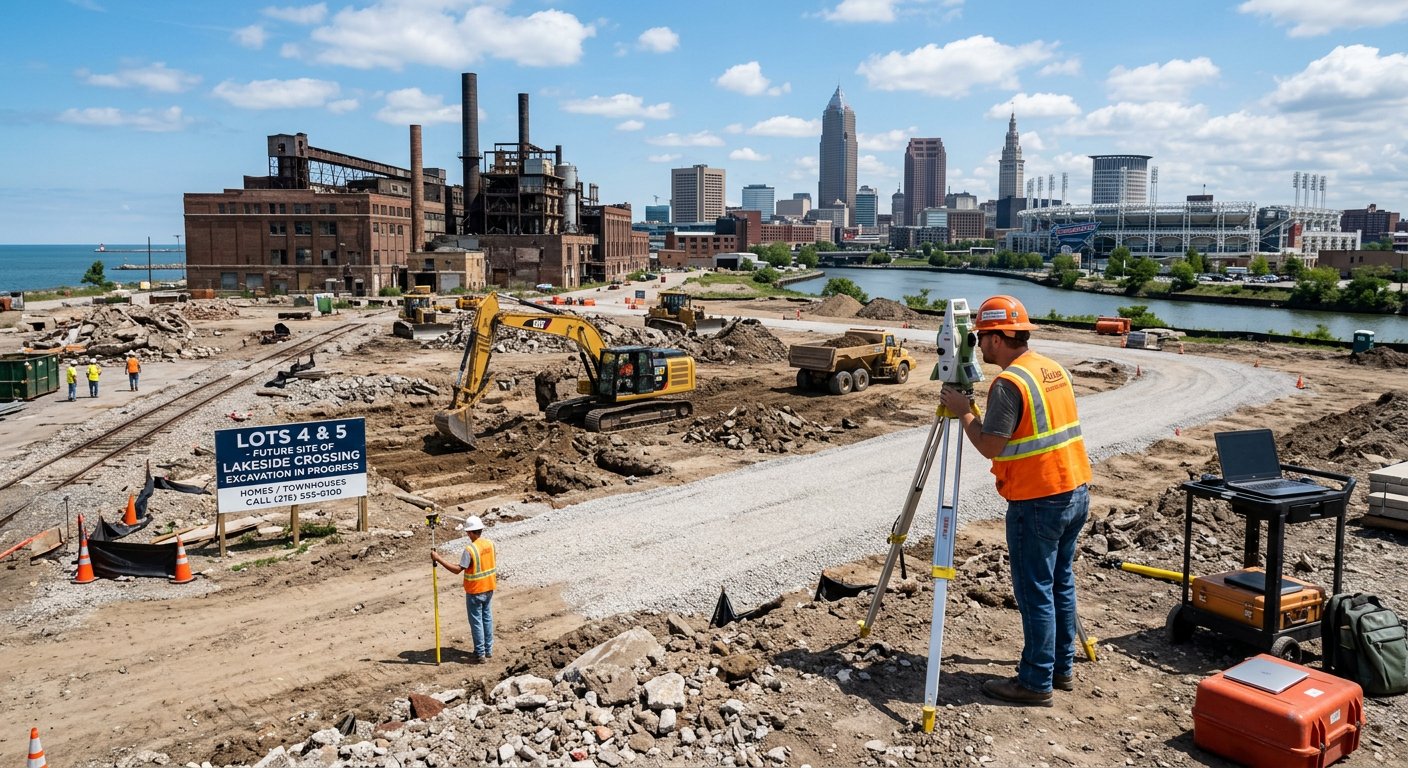
Derek Anders discusses the technical realities and high costs of building housing on Cleveland’s industrial brownfields, from vapor barriers to soil capping.
In Northeast Ohio, we have a surplus of land that looks like a great deal on a spreadsheet but fails when you put a shovel in the ground. At Lime Companies, we spend a lot of time looking at urban-infill affordable housing sites across Cleveland, Akron, and Canton, and the reality of brownfield redevelopment is rarely as clean as the brochures suggest. Most people see an empty lot in a neighborhood like Slavic Village or Detroit-Shoreway and assume it is ready for a new build-to-rent project or a small semi-custom home. The truth is that decades of industrial activity have left a legacy that we have to manage through rigorous technical processes before a single foundation can be poured. We do not shy away from these sites, but we approach them with a level of caution that often surprises stakeholders who are used to the faster pace of greenfield development in the outer suburbs of Summit County.
When we identify a potential site for a Lime Neighborhoods project or a sober living house, the first step is always the environmental due diligence. A Phase I Environmental Site Assessment is essentially a paper trail search of what happened on that dirt fifty or eighty years ago. In Cleveland, that history usually involves machine shops, dry cleaners, or small-scale manufacturing that didn't follow modern disposal standards. If the Phase I flags recognized environmental conditions, we move immediately into a Phase II ESA. This is where we actually pull soil borings and install monitoring wells to see what is living in the groundwater. You cannot guess your way through this. We are looking for heavy metals, volatile organic compounds, and petroleum hydrocarbons. The costs for these tests add up quickly, often reaching into the five-figure range before we even know if the site is buildable for residential use under Ohio EPA standards.
The data we get back from a Phase II determines our remediation strategy, which usually falls into three categories: removal, capping, or mitigation. For many of our urban-infill affordable housing projects, the most practical solution is soil capping. This involves covering the existing contaminated soil with a geotextile fabric and then placing two feet of clean, tested fill on top. It sounds simple, but the logistics of hauling hundreds of truckloads of clean dirt into a tight neighborhood like Old Brooklyn or Hough are significant. You have to ensure that the clean cap remains undisturbed for the life of the building. This requires legal deed restrictions called environmental covenants that tell future owners they cannot dig past a certain depth without a specific plan. This is the slow truth of brownfields; you are never truly finished with the site history, you are just managing it in perpetuity.
Vapor intrusion is another technical hurdle that people often overlook until they are deep into the design phase. If the Phase II shows high levels of volatile organic compounds like TCE or PCE in the soil or groundwater, there is a risk that those chemicals will off-gas into the crawlspace or basement of the new homes. In these cases, we have to install a vapor barrier and often a passive or active sub-slab depressurization system. This is essentially a heavy-duty plastic liner placed under the concrete slab, sealed around all pipe penetrations, and connected to a venting system that carries any trapped gases above the roofline. It is the same technology used for radon mitigation, but the stakes are higher when you are dealing with industrial solvents. It adds a layer of complexity to our plumbing and foundation crews who have to be careful not to puncture the membrane.
Building semi-custom homes on these lots requires a high degree of transparency with our buyers. We want people to understand that just because a site was once a gas station or a small factory doesn't mean it can't be a safe, beautiful place to live, provided the engineering is done right. However, the cost of that engineering has to be accounted for in the final price of the home. This is the friction point in urban redevelopment. We are trying to provide affordable housing options, but the cost to make an urban lot 'safe' often exceeds the cost of purchasing a clean acre of land in a township further south. We stay focused on Cuyahoga and Summit Counties because the demand for housing in these core areas is high, but we have to be disciplined about our margins to account for these unavoidable environmental expenses.
A major part of our work involves navigating the Ohio Voluntary Action Program, or VAP. This is a framework where we work with a Certified Professional to investigate and clean up a site to a standard that earns a Covenant Not to Sue from the state. This piece of paper is vital for financing. Most lenders will not touch a brownfield project without some form of state-level closure. The process is famously slow and pedantic, often taking a year or more just to get through the paperwork and testing cycles. For a developer, time is money, but in the world of Cleveland brownfields, moving too fast is a recipe for a lawsuit or a project-killing discovery halfway through construction. We build this time into our pro formas for every sober living or build-to-rent community we plan.
Managing stormwater on a capped site provides its own set of challenges. In neighborhoods like West Boulevard or St. Clair-Superior, we have to be careful that our drainage systems do not inadvertently create new pathways for sub-surface contamination to migrate. If we are putting in a detention basin or an underground storage vault for a larger Lime Neighborhoods project, we have to ensure the excavation doesn't breach the protective layers we’ve established. Sometimes this means we use lined basins that prevent water from infiltrating back into the contaminated lower stratums. Every decision we make about how water moves across the property is tied back to that original Phase II report. You aren't just designing a house; you are designing a complex environmental seal that has to last for decades.
We often find that the most difficult sites are those with small, scattered footprints. When we do urban-infill work, we might be looking at three or four non-contiguous lots. Doing a full environmental cleanup on a single narrow lot for one semi-custom home is often economically impossible. This is why you see so many vacant lots sitting empty for thirty years. The cost to prove they are safe is higher than the value of the land itself. At Lime, we try to mitigate this by grouping projects together or working closely with the Cuyahoga County Land Bank. They do a great job of early-stage assessment, but the developer still carries the ultimate responsibility once the deed transfers. We have to be experts in both the dirt and the law to make these inner-city projects work.
The reality of the soil in Northeast Ohio is that it is often heavy clay, which holds onto contaminants longer than sandy soils would. When we are working on a site in Akron, for example, we might find that old rubber manufacturing byproducts have leached into the clay and stayed there for half a century. Unlike some parts of the country where you can wash out the soil through natural filtration, here we are often stuck with it. This reinforces the need for solid capping strategies and the use of raised foundations or slabs-on-grade rather than deep basements. Avoiding deep excavations is often the most cost-effective way to develop a brownfield because it minimizes the amount of hazardous waste we have to haul to a specialized landfill, which charges by the ton.
Sober living houses present a unique opportunity for brownfield reuse because they are often larger, congregate-living structures that can justify the infrastructure costs of a specialized site. When we develop these, we are looking for locations that are close to transit and jobs, which almost always means we are in an older industrial or commercial corridor. The environmental hurdles are simply the price of entry for being in a high-impact location. We view the installation of vapor barriers and the importing of clean topsoil as an investment in the long-term health of our residents. It is about creating a truly safe environment, not just one that looks good from the street. There is no shortcutting the technical requirements when you are housing vulnerable populations.
Infrastructure is another hidden cost of these sites. Often, when we dig to hook into the city water or sewer lines in Cleveland, we find that the old pipes are surrounded by contaminated bedding material or that the pipes themselves are compromised. We have to be prepared to replace more than just what is on our property line. This is the 'slow truth' I am talking about; every time you think you have a handle on the budget, a brownfield site will throw you a curveball. We have learned to carry much higher contingencies on our urban-infill projects than we do on anything else. If you don't have a 15% to 20% cushion, you are setting yourself up for failure before you even finish the foundation.
Despite all the technical headaches and the slow pace of the Ohio EPA, we believe this work is the most important thing we do at Lime Companies. We are taking land that has been a liability for the neighborhood—collecting trash, lowering property values, and posing potential health risks—and turning it into a productive asset. Whether it is a new build-to-rent streetscape or a single semi-custom home in a recovering area of Canton, we are solving a historical problem. It requires a lot of boring, technical work and a massive amount of patience with soil engineers and laboratory results. But at the end of the day, we are providing housing in the places that need it most, and we are doing it the right way.
In conclusion, anyone looking to get into urban redevelopment in Northeast Ohio needs to spend more time studying the dirt than the architecture. The buildings are the easy part; the environmental legacy of our industrial past is the real challenge. At Lime, we have committed ourselves to this slow process because we know that the future of our cities depends on our ability to reclaim these brownfields. It isn't flashy work, and it certainly isn't fast, but it is the foundation of every project we build in Cuyahoga, Summit, and Stark Counties. We will keep pulling the samples, installing the barriers, and placing the caps, because that is what it takes to build a sustainable, safe community in the heart of the Rust Belt.
Next up
Garage Design for Northeast Ohio Reality
Developing the future of Northeast Ohio — one neighborhood at a time.
© 2026 Lime Companies LLC. All rights reserved.
Built in Northeast Ohio.