
Workforce
Framing Crews Through an Ohio Winter
By Derek Anders • September 18, 2025 • 8 min read
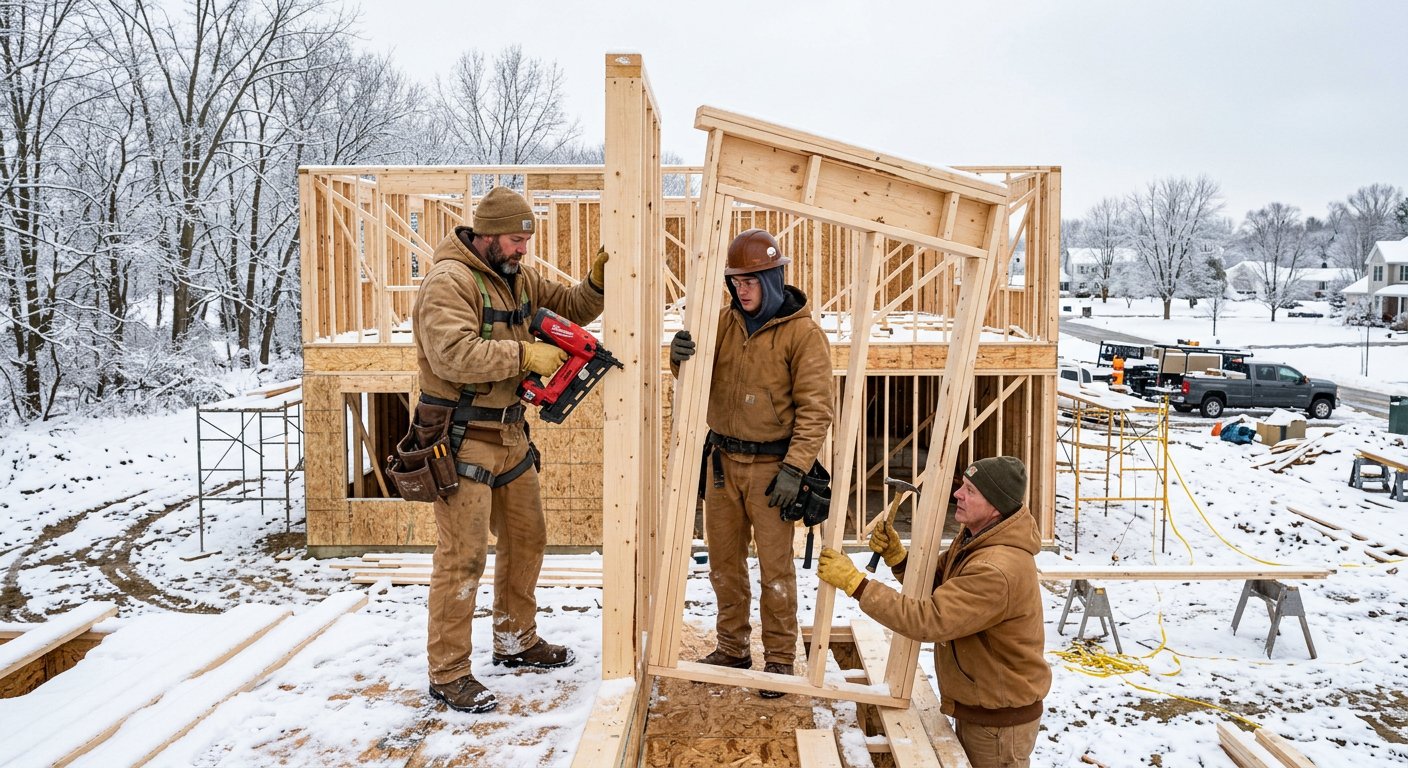
Derek Anders discusses the technical logistics and site management required to keep Lime Companies framing crews productive during a Northeast Ohio winter.
In Northeast Ohio, we do not have the luxury of shutting down operations just because the lake effect starts rolling in off Lake Erie. At Lime Companies, we maintain a strict production schedule across Stark, Summit, and Cuyahoga Counties regardless of the thermometer, but doing so requires a fundamental shift in how we manage our framing crews and material logistics. Between December and March, the goal isn't just to keep building; it is to manage moisture content and crew safety while keeping the vertical progress consistent. Whether we are framing an urban-infill affordable housing unit in a tight Akron lot or a semi-custom home out in a more exposed part of Stark County, the technical approach to the envelope has to be precise. We focus on the sequence of the build to ensure that the structure is dried in as quickly as possible to protect the subflooring and the interior studs from the freeze-thaw cycles that define our local winters.
The first technical hurdle we face during these months is site preparation and foundation accessibility. If we are pouring footers in December for a new Lime Neighborhoods build-to-rent project, we are already fighting the frost line. We use insulated blankets and sometimes ground heaters to ensure the concrete cures correctly before the framing crew even arrives. Once the deck is on, the real work begins. Snow removal becomes a daily technical task rather than a maintenance chore. We cannot allow snow to sit on untreated OSB subflooring because the moisture will seep into the edges, causing swelling that ruins the tolerances for our finish flooring later. My crews are trained to clear the deck before the first hammer swings each morning, often using heavy-duty blowers or specialized scrapers. We treat the subfloor with water-repellent coatings when possible, but the primary defense remains manual removal and careful timing of the local weather windows provided by the lake effect bands.
Wind chill is a significant factor in Summit and Cuyahoga Counties, particularly when we are working on two-story infill projects where the wind whips between existing homes. For our framing crews, clothing is a matter of thermal regulation and safety. We move away from heavy, bulky coats that restrict movement and instead utilize high-performance moisture-wicking layers. From a management perspective, I have to account for shorter daylight hours and the physical toll of working in sub-zero temperatures. We adjust our shift starts to maximize the highest arc of the sun, even if that only gives us a narrow window of relative warmth. Productivity naturally slows when a carpenter is wearing gloves, so we factor a fifteen percent buffer into our framing timelines for winter starts. This is not about being soft; it is a technical reality of handling cold steel fasteners and frozen lumber that becomes more brittle and prone to splitting when the temperature drops below twenty degrees.
When we frame our sober living houses, which often involve rehabilitating older structures or adding significant additions in established urban neighborhoods, we have to be extremely careful with lumber storage. Wet lumber is the enemy of a straight wall. If a delivery of studs sits in a slushy lot in Cleveland for three days, those boards will warp as soon as the heat is turned on inside the house. We coordinate deliveries to be just-in-time, meaning the lumber for the second floor doesn't arrive until the first floor is sheeted. We stack everything on dunnage, at least six inches off the frozen ground, and keep it wrapped until the moment it is needed for the saw. This level of logistical coordination prevents the expensive rework that occurs when a wall bows out after the drywall is hung because the studs were installed with a high moisture content that later equilibrated in a heated environment.
The equipment we use also requires a winter-specific maintenance schedule to avoid downtime. Pneumatic nail guns are notoriously finicky in an Ohio January. The moisture in the compressed air lines freezes, leading to ice blockages that can shut down a crew for hours. To combat this, we use winter-grade tool lubricants and integrated air dryers on our compressors. In some cases, we switch to gas-actuated framing nailers for smaller tasks where dragging a frozen hose across a slick roof is too dangerous. For our larger build-to-rent developments, we keep our compressors in heated enclosures or inside a partially enclosed garage space as soon as the walls are up. Keeping the tools at a functional temperature is just as important as keeping the crew warm, as a jammed gun leads to frustration and shortcuts that compromise the structural integrity of the framing we are putting our name on.
Safety on a winter job site in Northeast Ohio revolves largely around fall protection and footing.
When we are framing semi-custom homes, the roof pitches can be aggressive. Frost on a plywood roof deck is incredibly deceptive; it can be invisible and slicker than pure ice. We mandatory-link all framers to fall arrest systems the moment they leave the ground, and we use specialized grip shoes or cleats when working on high-pitch rafters. We also pay close attention to the wind speeds coming off the lake. There is a specific threshold where we stop setting trusses. High winds can turn a 40-foot gable truss into a sail, endangering the crew and the crane operator alike. We monitor local weather stations in real-time, often looking at the radar for Cuyahoga and Summit counties specifically, to decide if we are going to pivot to interior partition framing or stay on the roof.
In our affordable housing projects, we often work on smaller foot-prints where space for material staging is limited. This becomes even more complex when there are snow piles taking up half the lot. We have to coordinate with our excavators to ensure snow is pushed to areas that won't interfere with the delivery of floor joists or wall panels. Logistics in the winter is a game of inches. If a delivery truck gets stuck in the mud or snow on a tight Akron street, it can derail the entire week's production. We keep a supply of grit and salt on-site, though we are careful about where we salt to avoid damaging new concrete. The technical coordination between the site supervisor and the delivery driver is constant during these months, as we have to ensure the path to the foundation is clear and stable enough to support a heavy boom truck.
One of the technical advantages of building through the winter is that it forces us to be more disciplined with our house wraps and window installations. We want the house dried in as fast as humanly possible so we can bring in temporary heat. This allows the framing to begin the drying process before the mechanical contractors arrive. We use high-quality flashing tapes that are rated for cold-weather adhesion, as standard tapes often lose their stickiness below forty degrees. Ensuring a tight seal during a Northeast Ohio winter means we aren't chasing leaks when the spring rains eventually hit. For Lime's sober living and affordable housing units, this early attention to the building envelope also means we can move into the interior finish phase sooner, keeping our overall project timelines on track despite the seasonal weather hurdles.
Temporary heat is another major consideration for my framing crews. Once the roof is on and the windows are in, we aren't just heating for comfort; we are heating to allow the wood to stabilize. We typically use propane construction heaters, but we have to be careful about the moisture they introduce into the air. Propane combustion releases water vapor, which can condense on cold surfaces and lead to mold issues if not properly vented. We often use electric heaters for interior work or ensure that there is enough air exchange to keep the humidity levels managed. This is particularly important in our semi-custom builds where we might have expensive engineered wood products that are sensitive to extreme humidity swings. Managing the climate inside the shell is a technical requirement that continues long after the last framing nail is driven.
The psychological aspect of framing in the winter cannot be ignored, even from a technical standpoint. Cold crews are less productive and more prone to making mistakes. We make sure there is a heated break area on every Lime project, whether it’s a job site trailer or a designated room in a partially finished build. Providing a place to thaw out and dry off gear is essential for maintaining a high standard of craftsmanship. When a framer is shivering, they aren't checking for plumb and square with the same level of care. By managing the site environment and the crew’s wellbeing, we ensure that the quality of a home built in January is identical to one built in June. We pride ourselves on the consistency of our builds across the region, and that starts with the guys holding the saws in the snow.
Our commitment to urban-infill affordable housing in neighborhoods like North Hill or West Akron means we often deal with older infrastructure. During winter, frozen pipes or blocked sewer lines on the street can complicate our site water needs. We have to be self-sufficient, often bringing in water for specific tasks or ensuring our temporary power poles are protected from ice build-up that can cause shorts. These small technical details are what keep a project moving. While other developers might wait for the ground to thaw in April, we use the winter months to get ahead of the curve. By the time the spring market hits, our winter-framed houses are already in the trim phase, allowing us to deliver units to the market when inventory is historically at its lowest across Northeast Ohio.
Ultimately, framing through an Ohio winter is about respect for the elements and a commitment to technical standards. We don't cut corners on our sober living homes or our semi-custom residences just because it's ten degrees outside. We use the right fasteners, we protect our materials from the snow, and we manage our crews with a balance of production pressure and safety. Lime Companies has built a reputation in Stark, Summit, and Cuyahoga Counties by being the team that doesn't stop. Whether we are building a multi-unit Lime Neighborhoods project or a single-family infill home, the framing is the skeleton of the house. We make sure that the skeleton is built right, regardless of what the lake effect is doing. Staying productive in the winter is how we honor our commitments to the communities we serve and the residents who will eventually call these houses home.
Next up
Brownfield Redevelopment in Cleveland: The Slow Truth
Developing the future of Northeast Ohio — one neighborhood at a time.
© 2026 Lime Companies LLC. All rights reserved.
Built in Northeast Ohio.