
Market
How School District Boundaries Shape Where We Build
By Derek Anders • September 25, 2025 • 8 min read
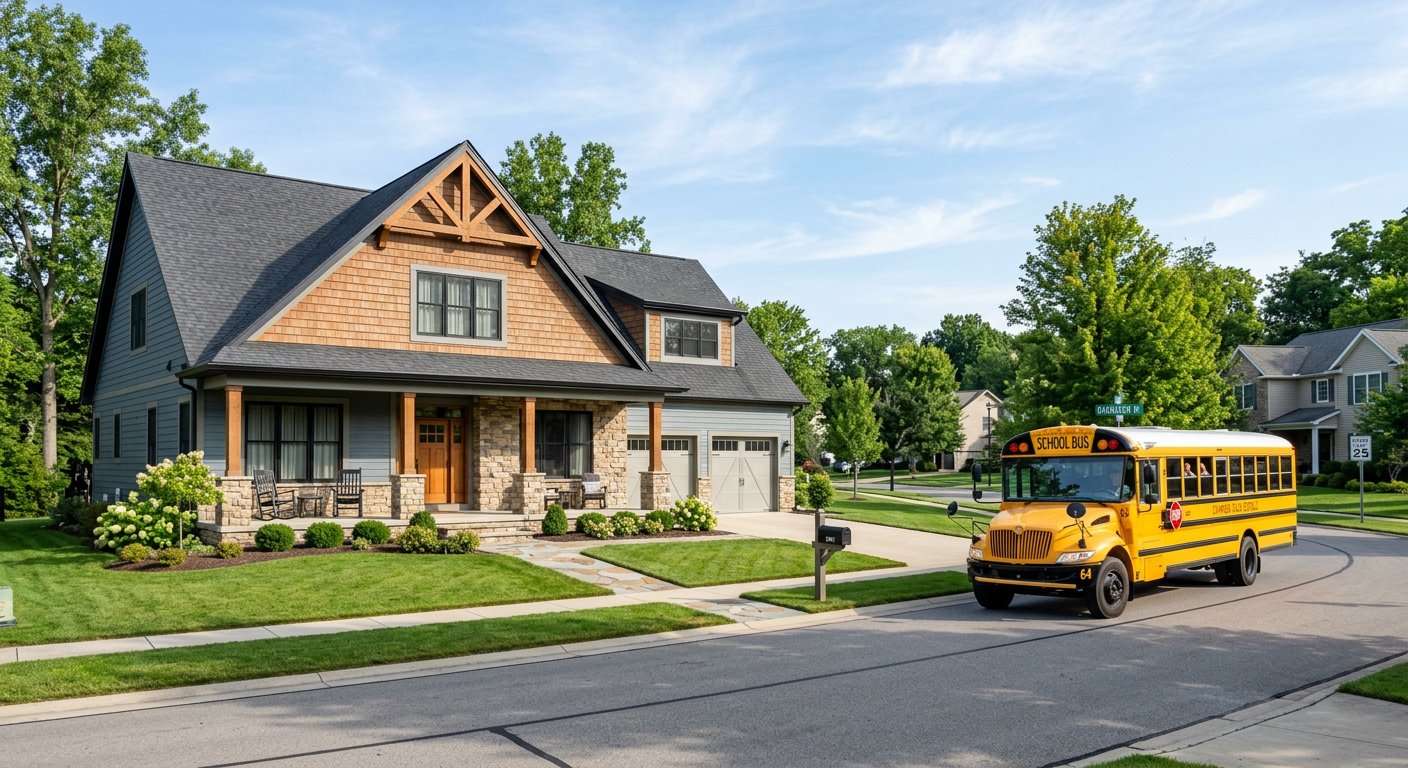
I break down how school district boundaries in Summit and Stark Counties dictate our site selection, construction costs, and the viability of our housing models.
When we look at a potential land acquisition in Northeast Ohio, the first map I pull up isn't the topographical survey or the utility hookup layout. It is the school district boundary map. In counties like Summit and Stark, these lines are often irregular and can change the underlying value of a parcel by twenty or thirty percent without changing a single physical attribute of the dirt. At Lime Companies, we have to navigate these borders because they dictate the exit strategy for every home we build. If a plot sits in the Akron city limits but falls within the Copley-Fairlawn school district, the demand profile shifts dramatically compared to the same plot three blocks over in the Akron Public Schools zone. This isn't a commentary on the quality of education but a reflection of the market reality and the specific demographics we target for our four core housing products.
For our urban-infill affordable housing projects, the school district boundary often determines whether a project is financially viable through various tax credit programs or local grants. In neighborhoods like West Akron or parts of North Hill, we are looking for ways to densify without overextending the price point for a first-time homebuyer. If we are building for-sale infill, a district that is perceived as higher-performing allows us to justify the higher material costs associated with building modern, energy-efficient envelopes. People will pay a premium for a smaller footprint if it secures their spot in a specific district. Conversely, if we are building in a more challenged district, we have to be extremely disciplined with our floor plans to ensure the final appraised value doesn't come in below our hard construction costs. It forces a technical efficiency in our design that most developers ignore.
Our semi-custom home division operates on a different logic, focusing heavily on executive-level infill and suburban fringe lots in Stark County. When we look at Jackson Township or North Canton, the school district is the primary driver of the sales price. In these areas, we aren't just selling a four-bedroom colonial; we are selling a long-term asset. When I’m analyzing a site for a semi-custom build, I’m looking at the mil rate of the district and how it impacts the monthly escrow for the buyer. A high-tax district might offer great schools, but it also lowers the maximum loan amount a buyer can qualify for. We have to balance the architectural aspirations of the home with the fiscal reality of the property tax burden. If we over-build a semi-custom home in a high-tax district, we risk shrinking our pool of eligible buyers to a point where the project sits on the books too long.
One of the most interesting ways these lines affect our workflow is through the Lime Neighborhoods build-to-rent model. In the rental market, school districts are the ultimate filter for the long-term stability of a tenant base. When we develop a cluster of rental homes in Stow or Cuyahoga Falls, we are looking for districts that attract families who plan to stay for five to ten years. High residential turnover is the silent killer of a rental portfolio’s bottom line. By building in stable, mid-to-high-tier school districts, we naturally select for a tenant profile that values consistency. These families want their kids to graduate with the same cohort they started with, which means they are less likely to move out over a minor rent increase or a job change that stays within the Northeast Ohio region. This stability allows us to project more accurate long-term yields.
Sober living houses present a different technical challenge regarding boundaries. For these projects, we aren't usually looking for top-tier school districts because the residents aren't typically bringing children into the home. However, the proximity to school zones still matters for zoning and regulatory compliance. Many municipalities in Summit County have distance requirements that prevent certain residential care facilities from being within a specific radius of a school building. When we acquire a property for our sober living partners, we have to verify that the home doesn't trigger a special use permit conflict simply because it sits on the edge of a district's elementary school campus. It is a technicality that can kill a deal in the due diligence phase if you aren't paying attention to the specific physical location of every school building in the district.
The fragmentation of Northeast Ohio’s school districts also creates unique opportunities for what I call border-line arbitrage. In places where the border between the Plain Local and Canton City districts is blurred, you can sometimes find parcels that are priced like city lots but carry the school designation of the township. This is where our land acquisition team spends a lot of time. We look for those geological or historical quirks where a single street might be split down the middle. Building a Lime Neighborhood build-to-rent project on the favorable side of that line allows us to offer a product that feels like a bargain to a young family while still maintaining our required profit margins. It requires a granular knowledge of the tax maps that goes far beyond what a typical real estate agent provides.
From a construction standpoint, the district often influences the level of finish we include in our standard specs. If we are building in an area where the schools are a major draw, we know we can invest more in the mechanical systems and the durability of the interior finishes. We might opt for a higher-efficiency HVAC system or more resilient flooring because we know the asset will appreciate at a rate that covers those upfront costs. In districts with lower demand, we have to prioritize the essential structural integrity and energy performance but might pull back on the aesthetic upgrades to keep the house affordable for the local workforce. It is a constant game of give and take that is entirely dictated by the geographical boundaries drawn decades ago.
I often find that people underestimate how much these boundaries affect the density of a development. In high-demand districts in Summit County, the land cost is so high that the only way to make the numbers work is through density. This is where our urban-infill affordable housing and build-to-rent models intersect. We might push for a higher unit count on a smaller acreage if we are within a desirable district because the market demand will support a tighter living environment. People are willing to sacrifice a large backyard if it means their children are in a specific school system. This allows us to maximize the utility of the land while providing a housing option that wouldn't otherwise exist in those more expensive suburban enclaves.
The technicality of these boundaries also extends to the infrastructure and utility agreements between cities and school districts. Sometimes, a district line doesn't follow the municipal line, which creates a nightmare for permitting and tap-in fees. I have seen projects in Stark County where the house is in one city, but the school district is tied to a neighboring township. This often leads to confusion regarding which building department has jurisdiction and how the property will be taxed. We have to vet these issues during our initial feasibility studies. If the bureaucratic friction of a split-jurisdiction lot is too high, it doesn't matter how good the school district is; the project will fail due to the time and cost of the pre-development phase.
Our commitment to sober living and affordable housing means we often work in the core of Akron and Canton where the school districts are under significant pressure. In these markets, we focus on the walkability and the proximity to community resources rather than the school rating alone. However, we still have to be aware of how the district's performance impacts the long-term appraisal. If a district is in a state-mandated recovery plan, it can affect the interest rates lenders are willing to offer for a multi-family project or a build-to-rent cluster. We have to mitigate that risk by ensuring our designs are top-notch and our management practices are professional, showing the bank that the physical asset is stronger than the surrounding socio-economic volatility.
Looking forward, I expect these district boundaries to become even more influential as the housing shortage in Northeast Ohio continues. As more people move back into the region or shift from the higher-priced Cleveland markets into Summit and Stark, they are going to be hyper-focused on where their tax dollars are going. At Lime Companies, we are positioning our land bank to take advantage of this by securing lots in transitions zones. We want to be the developer that provides a semi-custom feel at an affordable price point, and the only way to do that is to understand the math behind the district lines. It isn't just about where we want to build; it’s about where the math says the community is going to grow.
Ultimately, my job at Lime is to manage the risk of the dirt. Everything we do, from our four focus areas to our neighborhood selections, is about reducing the variables that could lead to a loss. School district boundaries are one of the few variables that are relatively fixed and highly predictable in terms of market reaction. By aligning our construction pipeline with the districts that show the most stability and growth, we are protecting our investors and our residents. It is a technical, often tedious process of mapping and verification, but it is the foundation of every successful project we have delivered in Cuyahoga, Summit, and Stark counties over the last several years.
We don't go into a neighborhood and try to force a product that doesn't fit the data. If the district lines suggest that a high-end semi-custom home won't appraise, we pivot to a build-to-rent model or an affordable infill project. The land tells us what it wants to be, and the school district is a major part of that conversation. By staying disciplined and respecting these invisible borders, we can continue to build homes that are both functional for the residents and profitable for the company. It’s about being a local developer who actually knows the local terrain, down to the specific street where the school bus changes direction and the property values shift overnight.
In the end, navigating these boundaries is what separates a regional developer from a national builder who just sees a zip code. We see the nuance of the neighborhood. Whether it is a sober living house in a quiet corner of Summit County or a new Lime Neighborhood in Stark, we are looking at the long-term impact of those district lines. They are the scaffolding upon which we build our business. As we move into the next phase of our development cycle, we will continue to use this technical approach to ensure that every home we put on the map is placed with precision and a clear understanding of the local educational landscape.
Next up
Framing Crews Through an Ohio Winter
Developing the future of Northeast Ohio — one neighborhood at a time.
© 2026 Lime Companies LLC. All rights reserved.
Built in Northeast Ohio.